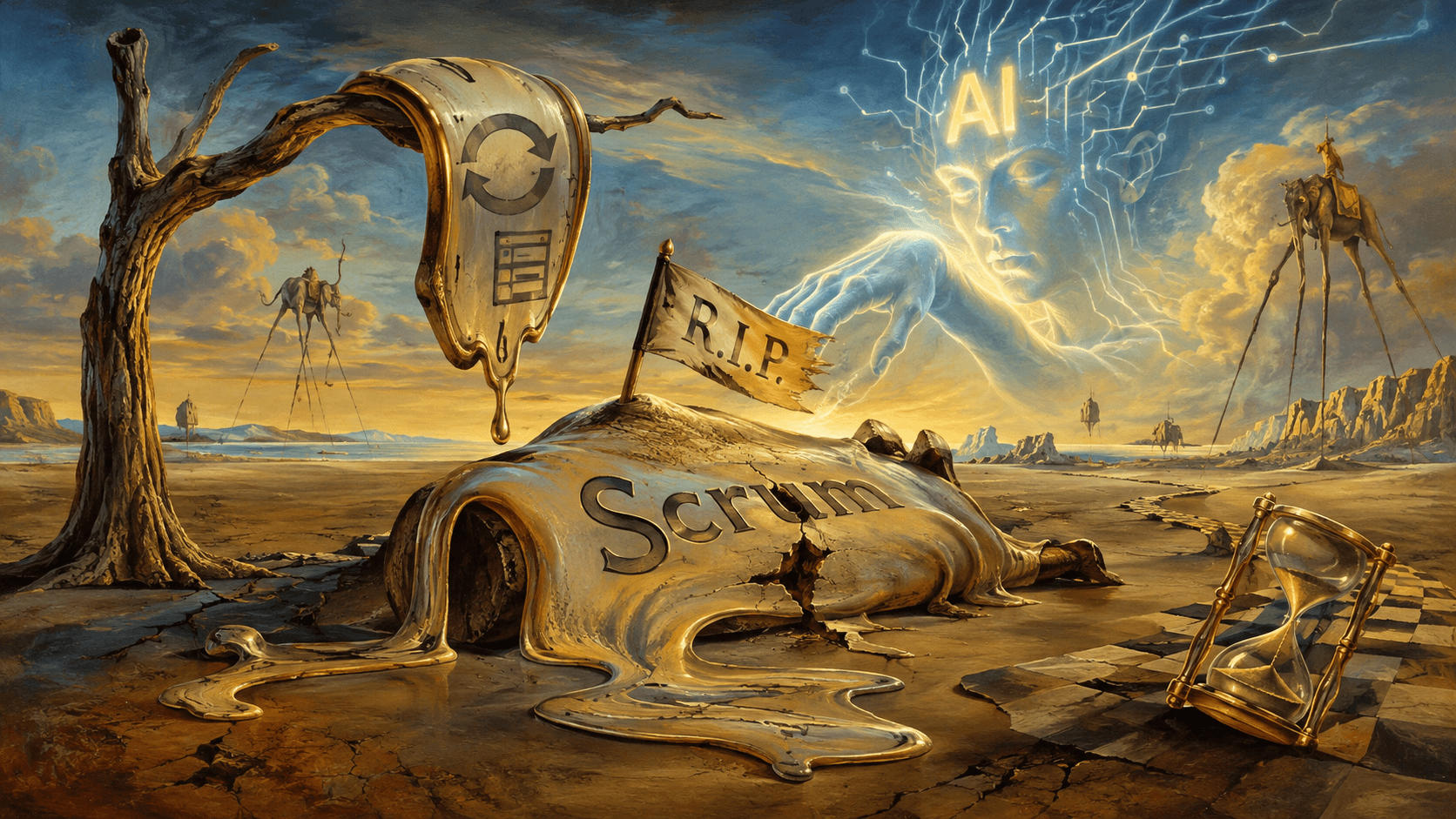
Yes, Scrum is dead, but not the one you're thinking of: what died is ceremonial Scrum, the one with two-week sprints as a sacred unit, story points, the calendar-keeping Scrum Master and the PO→UX→Dev handoffs. What did NOT die, and won't, is agility: Empiricism, inspection and adaptation, and an obsessive focus on value.
TL;DR
Ceremonial Scrum was already wounded, and AI finished it off: When a coding agent produces a working first version in hours, planning, estimating and "committing" work in two-week blocks no longer makes sense. The State of Agile 2025 didn't even ask about team frameworks, and 74% of organizations say they use hybrid or custom models.
The market has already voted, with nuances: Capital One eliminated around 1,100 "agile" roles in 2023 by folding them into engineering and product, Scrum Master job postings in the UK collapsed in 2025 (with a partial rebound in 2026), and LinkedIn replaced its Associate Product Manager program with an Associate Product Builder program.
Watch out for the hype: AI doesn't speed things up on its own (METR measured developers 19% slower in 2025, and DORA 2025 shows more throughput but also more instability). What survives is the structural part of Scrum (empiricism, small teams, value), in the hands of a new profile: The Product Builder.
Every so often the same post shows up on LinkedIn: "Agile is dead", with a Canva tombstone, two hundred comments from outraged agile coaches and another two hundred from developers applauding. I usually scroll past it, because we've been having this debate since 2014 (we'll get to that). But a few weeks ago something different happened to me: In a roadmap review, in an organization with more than a hundred people in Product and Technology, someone on the team showed a working prototype, with real data, connected to our API, that they had built in one afternoon with a coding agent, and they did it before the corresponding user story even reached sprint refinement. The story was estimated at 8 points, planned for the next sprint and with its design "pending UX". The prototype already existed. Nobody really knew what to do with the story.
A key question, on purpose: If the first version of almost anything costs hours and not weeks, why does a two-week sprint still exist?
In this post we'll go step by step. First, let's look at what Scrum really is (and what it isn't), because there's a lot of smoke around it; then, how it turned into ceremony; after that, what changes with AI, with data and no hype; then, the uncomfortable point about the job market and the companies that have already moved; and finally, the new Product Builder role, the honest counterpoint and my position.
First things first: What is Scrum (and what is agility)?
Let's be honest: Most people who say "we do Scrum" have never read the Scrum Guide, which is less than 15 pages long. So let's look at the correct definition of Scrum, according to its creators:
"Scrum is a lightweight framework that helps people, teams and organizations generate value through adaptive solutions for complex problems."
(Source: Schwaber, K. & Sutherland, J. (2020). The Scrum Guide. Scrum.org / Scrum Inc. https://scrumguides.org/scrum-guide.html)
Notice what it says and what it does NOT say. It doesn't say "two-week sprints" (the guide says "one month or less"), it doesn't say "story points" (the term doesn't appear in the guide), it doesn't say "Jira". What it does say is that Scrum is founded on empiricism and lean thinking, with three pillars: Transparency, inspection and adaptation.
Its origin isn't even software. The term comes from rugby, and Hirotaka Takeuchi and Ikujiro Nonaka used it in 1986 to describe how companies like Honda or Canon developed products with small, multidisciplinary, self-organizing teams (Source: Takeuchi, H. & Nonaka, I. (1986). The New New Product Development Game. Harvard Business Review. https://hbr.org/1986/01/the-new-new-product-development-game). Ken Schwaber and Jeff Sutherland formalized it for software in 1995 (OOPSLA), and in 2001 both of them signed, along with fifteen others, the Agile Manifesto:
"Individuals and interactions over processes and tools. Working software over comprehensive documentation. Customer collaboration over contract negotiation. Responding to change over following a plan."
(Source: Beck, K. et al. (2001). Manifesto for Agile Software Development. https://agilemanifesto.org)
And here comes the important part: Scrum is a tool, agility is the phenomenon. Scrum was a very good answer to a concrete problem of the nineties: Building software was expensive, slow and risky, so it made sense to package work into short iterations to inspect and adapt. The problem is that at some point we confused the tool with the phenomenon.
How did we go from empiricism to ceremony?
The criticism isn't new, and it comes from the inside. In 2014, Dave Thomas, one of the signatories of the Agile Manifesto, published a post titled nothing less than "Agile is Dead (Long Live Agility)", where he said the word "agile" had become a commercial label: "We've lost the word agile. Let's try to hang on to agility" (Source: Thomas, D. (2014). Agile Is Dead (Long Live Agility). PragDave. https://pragdave.me/blog/2014/03/04/time-to-kill-agile/). Four years later, Martin Fowler, another signatory, named the culprit in his Agile Australia keynote: The Agile Industrial Complex, that machinery of certifications, consultancies and frameworks that imposes processes on teams, something he called "an absolute travesty" (Source: Fowler, M. (2018). The State of Agile Software in 2018. martinfowler.com. https://martinfowler.com/articles/agile-aus-2018.html).
The ceremonial beat the structural: A 15-minute daily that lasts 45, a four-hour planning to estimate in Fibonacci, retros where everyone knows what to say, sprint reviews that are demos for the boss, and a Scrum Master whose main deliverable is making sure the ceremonies happen. Ron Jeffries, another signatory, gave it a name in 2016: "Dark Scrum", because "too often, at least in software, Scrum seems to oppress people", and in that scenario, he says, "self-organization cannot emerge" (Source: Jeffries, R. (2016). Dark Scrum. ronjeffries.com. https://ronjeffries.com/articles/016-09ff/defense/).
The data backs up this wear and tear. Digital.ai's State of Agile, the oldest longitudinal study on the subject (since 2006), took a revealing turn in its 18th edition, published on October 28, 2025: For the first time in its history it did not ask about team-level frameworks, nor about why agile is adopted; the whole report pivoted to AI. What it did report: 74% of organizations say they use hybrid or custom models, SAFe sits at 44%, and adoption of Scrum@Scale, LeSS and Nexus dropped (and I say this as a LeSS Certified Practitioner, so it hurts a little XD) (Source: Digital.ai. (2025). 18th State of Agile Report. https://digital.ai/resource-center/analyst-reports/18th-state-of-agile-report/; summary on Scrum.org: https://www.scrum.org/resources/blog/18th-state-agile-report). An important nuance, no hype: The sample was around 350 people, mostly agile coaches and consultants from large companies, so it's a thermometer of the "agile world", not of the whole industry.
And at the most critical end there's the famous study claiming that agile projects are 268% more likely to fail. Be careful with this figure: It was a survey of 600 engineers (250 in the UK and 350 in the US) conducted between May 3 and 7, 2024 by J.L. Partners, commissioned by the consultancy Engprax to promote Junade Ali's book Impact Engineering. The Register, which spread it, described it as a possible "thinly veiled plug" for that methodology (Source: Speed, R. (2024). Study finds 268% higher failure rates for Agile software projects. The Register. https://www.theregister.com/2024/06/05/agile_failure_rates/). I use it as a symptom of the discontent, NOT as evidence that agility fails: What it really measures is that projects without clear requirements fail more often, and that's not the Manifesto's fault, it's the fault of how we implemented it.
What changes with AI? The sprint loses its reason to exist
The sprint exists for an economic reason: If building is expensive, it makes sense to limit risk in short blocks and inspect at the end of each block. What happens when building becomes cheap?
Let's look at the data:
Near-universal adoption. Google's DORA 2025 report, based on more than 100 hours of qualitative data and responses from "nearly 5,000 technology professionals", found that 90% use AI in their work, 14 points more than the previous year, and more than 80% perceive their productivity has increased (Source: Google Cloud DORA. (2025). State of AI-assisted Software Development. https://cloud.google.com/blog/products/ai-machine-learning/announcing-the-2025-dora-report). The Stack Overflow Developer Survey 2025 says something similar: 84% use or plan to use AI tools, versus 76% in 2024 (Source: Stack Overflow. (2025). 2025 Developer Survey. https://stackoverflow.co/company/press/archive/stack-overflow-2025-developer-survey/).
The machine already writes the code. In March 2025, Jared Friedman, managing partner at Y Combinator, said that for a quarter of the Winter 2025 batch, 95% of the code was AI-generated, and he clarified these weren't non-technical founders (Source: Mehta, I. (2025). A quarter of startups in YC's current cohort have codebases that are almost entirely AI-generated. TechCrunch. https://techcrunch.com/2025/03/06/a-quarter-of-startups-in-ycs-current-cohort-have-codebases-that-are-almost-entirely-ai-generated). At Anthropic, a spokesperson told Fortune in January 2026 that, company-wide, between 70% and 90% of the code is written by AI, and around 90% in the case of Claude Code; Boris Cherny, who leads Claude Code, said he had shipped 22 pull requests in one day, "each one 100% written by Claude" (Source: Fortune. (2026). Top engineers at Anthropic, OpenAI say AI now writes 100% of their code. https://fortune.com/2026/01/29/100-percent-of-code-at-anthropic-and-openai-is-now-ai-written-boris-cherny-roon).
AI is no longer optional at some companies. On April 7, 2025, Tobi Lütke, CEO of Shopify, published his internal memo: "Reflexive AI usage is now a baseline expectation at Shopify", with AI usage questions in performance reviews and the requirement to show why AI can't do the job before asking for more headcount (Source: Lütke, T. (2025). Internal memo published on X; reported by Digital Commerce 360. https://www.digitalcommerce360.com/2025/04/08/internal-memo-shopify-ceo-declares-ai-non-optional/).
Now, the point isn't "AI codes faster". The point is structural: The cost of the first version changes. And when the first version costs hours, three things happen that break ceremonial Scrum:
The sprint stops being the natural unit of learning. If I can build, show a customer and discard three alternatives in one day, waiting for the sprint review to inspect is like checking your email once every two weeks.
Estimating with story points becomes theater. We estimated to manage the scarcity of development capacity. If an agent solves in 20 minutes what we estimated at 5 points, the Planning Poker discussion costs more than the work. What's scarce is no longer writing code, it's deciding what to build and validating that it works.
PO→UX→Dev handoffs become the bottleneck. When execution speeds up, what stays slow is the chain of handoffs: The story waiting for design, the design waiting for refinement, the refinement waiting for the sprint. Andrew Ng summed it up well: "Because we can now build fast, a greater fraction of time must be spent deciding what to build", and he warned that if a PM decides what to build and an engineer builds it, "the communication between them becomes a bottleneck" (Source: Ng, A. (n.d.). Post on X. https://x.com/AndrewYNg/status/2048793852702757151).
It's not that AI makes Scrum faster, it's that it changes the economics Scrum was designed on.
The uncomfortable point: The market has already voted
This is where I'm going to get uncomfortable, because I know and appreciate a lot of people who make a living from this.
In January 2023, Capital One eliminated around 1,100 roles from its "agile" job family, as reported by Bloomberg. The bank's explanation was surgical: "The agile role in our tech organization was critical to our earlier transformation phases but as our organization matured, the natural next step is to integrate agile delivery processes directly into our core engineering practices", and the responsibilities moved to existing engineering and product management roles (Source: Hrushka, A. (2023). Capital One cuts 1,100 tech jobs. Banking Dive. https://www.bankingdive.com/news/capital-one-cuts-1100-tech-jobs-agile/640861/). Careful: The bank never confirmed the exact figure, and it explicitly said it was not abandoning Agile (Source: The Register. (2023). https://www.theregister.com/2023/01/20/capital_one/). In other words: They didn't kill agility, they killed the role dedicated to managing it. That is exactly the thesis of this post.
Job postings tell the same story, with a nuance few people mention. According to ITJobsWatch, in the UK permanent Scrum Master postings in the six-month period to May 1, 2025 were 28, versus 98 in the same period of 2024 and 316 in 2023, a drop of around 91% in two years; for Agile Coach, the series fell to just 4 postings as of May 2025. But in the period to November 22, 2026 there were 99 Scrum Master postings, versus 29 a year earlier: A rebound, in an IT market that also recovered (Source: ITJobsWatch. (2026). Scrum Master jobs, UK. https://www.itjobswatch.co.uk/jobs/uk/scrummaster.do). My reading: The floor was 2025 and the role didn't disappear, but it changed; what's being hired today is less "ceremony facilitator" and more of a delivery, product or engineering profile.
Trainers feel it too. Peter Green, from Humanizing Work, said he taught the smallest Certified Scrum Master class of his career, and that every participant came from a company that had eliminated the Scrum Master and Agile Coach titles (Source: Humanizing Work. Why Agile Jobs Are Vanishing, and What to Do About It. https://www.humanizingwork.com/agile-jobs-are-vanishing/).
And in LATAM? No hype: I couldn't find a reliable data series on the evolution of Scrum Master job postings in Peru, Mexico, Colombia or Chile. What you can see in one-off LinkedIn searches is that Peru still has around a hundred Scrum Master postings, concentrated in banking, insurance and large fintechs. My hypothesis, as a hypothesis: In LATAM ceremonial Scrum will last longer, because many agile transformations arrived late and are still in their "installing ceremonies" phase. We arrived late to Scrum and, if we're not careful, we're going to arrive late to its funeral too.
Market cases: Who has already moved
This isn't theory. There are companies that redefined how they work a while ago:
Basecamp and Shape Up. Ryan Singer documented in 2019 a method with six-week cycles, followed by two weeks of cool-down, with no infinite backlog and with the concept of appetite: You don't estimate how long something will take, you decide how much time you're willing to invest and you design the solution within that limit (Source: Singer, R. (2019). Shape Up: Stop Running in Circles and Ship Work that Matters. Basecamp. https://basecamp.com/shapeup).
Linear. It uses cycles instead of sprints, and its own documentation clarifies that they're not tied to releases; the goal is to maintain healthy momentum, "not to rush towards the end", and unfinished work rolls over to the next cycle on its own, with no drama or re-estimation (Source: Linear. The Linear Method. https://linear.app/method). Nan Yu, its Head of Product, insists that unshipped code is debt.
Airbnb. At Config 2023, Brian Chesky said: "we got rid of the classic product management function". The next day he clarified that they turned it into an Apple-style product marketing function, and that program management moved to program managers (Source: Mind the Product. (2023). Airbnb's product management shift. https://www.mindtheproduct.com/airbnbs-product-management-shift-the-viewpoint-of-product-leaders/). The PM didn't die, the PM who acted as backlog administrator died.
LinkedIn, the clearest case. In December 2025, Tomer Cohen, LinkedIn's CPO, confirmed on Lenny Rachitsky's podcast that they eliminated their Associate Product Manager program and replaced it with an Associate Product Builder program, which started in January 2026: "We're going to teach them how to code, design, and PM at LinkedIn". They also created the formal title of Full Stack Builder, with its own career path, and are reorganizing into small pods of builders who "flex" between roles (Source: Lee, C. M. (2025). LinkedIn is scrapping its associate product manager program and rebuilding around full-stack talent. Business Insider; summary on The Linked Blog: https://thelinkedblog.com/2025/linkedletter-168-from-product-roles-to-premium-perks-linkedin-is-evolving-3744/). Careful with the exaggerated version going around: LinkedIn didn't fire its PMs, it redesigned the entry door.
Figma measured it from the talent side: In its Shifting Roles report (September 2025), with 1,199 respondents and 51 interviews, 64% identified with two or more roles, and more than a third said their responsibilities span three or more (Source: Figma. (2025). Are roles and responsibilities a thing of the past?. https://www.figma.com/blog/2025-shifting-roles-report/).
And what does the "other side" say? Something curious: Jeff Sutherland, co-creator of Scrum, isn't defending the ceremonies, he's writing books about Scrum teams of AI agents, such as Hermes: Organizations as Swarming Agents and First Principles in Scrum: OpenClaw Scrum and Scrum@Scale, where he argues that small teams of agents working "like great Scrum teams" outperform a single agent (Source: Leanpub. (2026). Hermes: Organizations as Swarming Agents, by Jeff Sutherland. https://leanpub.com/blog/leanpub-book-launch-hermes-organizations-as-swarming-agents-by-jeff-sutherland/). Careful, these are the author's own claims, not independent studies. But the message speaks for itself: Not even the creator of Scrum is defending the Scrum of human ceremonies, he's defending empiricism.
The new role: Product Builder (and much smaller teams)
So, what replaces the PO + UX + Dev trio with a Scrum Master as facilitator? My answer: The Product Builder.
There's no canonical definition yet (and be wary of anyone selling you a Product Builder certification, the Agile Industrial Complex learns fast XD), but taking what LinkedIn and others are doing, I define it like this: A person who can take an idea from the customer's problem to working software in production, combining product judgment, design and AI-assisted building, without depending on a chain of handoffs. Close cousins: The Product Engineer (an engineer with product ownership), the AI-native builder and the generalist builder of 1-3 person startups.
What's interesting is that even Marty Cagan, who has defended the empowered teams model for years, acknowledges it in his own way. In April 2026 he wrote that some product managers realized that with tools like Claude Code or Cursor they can take on more of the building, and that "there's nothing wrong with that"; but he adds the key distinction: The PM builds to learn (discovery), the engineer builds to earn (delivery) (Source: Cagan, M. (2026). Build to Learn vs Build to Earn. SVPG. https://www.svpg.com/build-to-learn-vs-build-to-earn/). For me that's the most useful sentence in this whole debate: The Product Builder doesn't replace solid engineering, it collapses discovery and prototyping into a single person, and that's what kills the handoffs.
How do teams change? What I'm seeing, and what I see in the market:
Smaller teams. Pods of 2 to 4 people with high autonomy, instead of squads of 8-10 with fixed roles.
Continuous flow instead of sprints. Learning cycles of days, continuous delivery, and a review rhythm (weekly, monthly) for strategy, not for the work.
Specifying instead of estimating. Spec-driven development (tools like GitHub Spec Kit or AWS's Kiro) shifts the effort toward writing intent well so an agent can execute it; the old requirements debate is back, but in the key of prompts and living specs.
Continuous discovery. Teresa Torres defines continuous discovery as "at a minimum, weekly touchpoints with customers by the team building the product, where they conduct small research activities in pursuit of a desired outcome" (Source: Torres, T. (2021). Continuous Discovery Habits. Product Talk), and that stops being a luxury and becomes the only reasonable brake against quickly building what nobody needs.
The honest counterpoint: AI isn't magic (and some data hurts)
Now, I don't want this to be another hype post. There's data that should temper the enthusiasm:
METR (July 2025): In a randomized controlled trial with 16 experienced open source developers and 246 real tasks in repositories they knew well, when AI was allowed the tasks took 19% longer. The most interesting part: Beforehand they expected to go 24% faster, and after finishing they still believed they had gone 20% faster (Source: Becker, J., Rush, N., Barnes, E. & Rein, D. (2025). Measuring the Impact of Early-2025 AI on Experienced Open-Source Developer Productivity. METR. https://metr.org/blog/2025-07-10-early-2025-ai-experienced-os-dev-study/). In February 2026, METR published a follow-up with 57 developers and more than 800 tasks, but acknowledged it delivers "an unreliable signal": Many developers refused to participate because they didn't want to work without AI, and between 30% and 50% admitted not submitting tasks they didn't want to do without it. METR believes there probably is a speedup today, but it can't measure it with that design.
DORA 2025: AI is now associated with more throughput, but it still has a negative relationship with delivery stability; according to Google's own blog post on the report, 30% of respondents trust AI-generated code "a little" (23%) or "not at all" (7%), versus only 24% who trust it "a lot" or "a great deal" (Source: Google. (2025). How are developers using AI? Inside our 2025 DORA report. https://blog.google/innovation-and-ai/technology/developers-tools/dora-report-2025/). The report's conclusion is that AI is an amplifier: It makes good teams better and makes teams that already had problems worse, faster.
Stack Overflow 2025: 46% don't trust the accuracy of what AI produces (versus 31% the previous year), and 66% say the answers are "almost right, but not quite".
Anthropic's 90%, under the magnifying glass: Dario Amodei predicted in March 2025 that within 3 to 6 months AI would write 90% of the code; an analysis by Redwood Research questioned whether that figure applied to the whole company and estimated the average was closer to 50% at that time (Source: Redwood Research. (2025). Is 90% of code at Anthropic being written by AIs?. https://blog.redwoodresearch.org/p/is-90-of-code-at-anthropic-being). "% of code written by AI" figures depend heavily on how they're measured.
What does this data tell me? That the speed of writing code is not the same as the speed of delivering value. And that, paradoxically, is an argument IN FAVOR of the structural part of Scrum: If AI amplifies, what you need to amplify is good habits. What survives, and becomes more important than ever:
Empiricism: Transparency, inspection and adaptation, now in cycles of hours, not weeks.
Definition of Done and quality: With more generated code and more instability, the discipline of "truly done" is worth gold.
Focus on value and on the Product Goal: When building is cheap, the risk is building a lot of the wrong thing.
Small, autonomous, multidisciplinary teams: Takeuchi and Nonaka said it in 1986; AI just took it to the extreme.
So, is Scrum dead or not?
My position, no hedging: Yes, Scrum as most of us practiced it is dead. The two-week sprint as a mandatory container, story point estimation, ceremonies as an end in themselves, the Scrum Master as calendar administrator and the PO→UX→Dev handoff chain belong to an economy where building was expensive. That economy is over. Continuing to defend the ritual is like defending the fax machine because "it always worked".
But empiricism didn't die. What died is the ceremonial; the structural is more alive than ever, and curiously it looks much more like Takeuchi and Nonaka's original Scrum, small multidisciplinary teams that "play" the whole match together, than the certified Scrum of the last fifteen years. It's not the end of agility, it's the end of agility as an industry.
If you lead Product and Technology, my concrete recommendation is this: Don't announce "we're dropping Scrum" (that only creates anxiety and a new replacement framework). Eliminate the ceremonial one ceremony at a time, asking yourself what decision each one enables, measure outcomes and stability instead of velocity, invest in continuous discovery and in quality, and start developing Product Builders from your most curious PMs, designers and engineers. And to Scrum Masters and Agile Coaches: Your value was never the ceremony, it was helping teams improve how they work; that know-how is more necessary than ever today, but it will live inside product, engineering or leadership roles, not in a dedicated role.
The underlying question isn't which framework to use. That answer isn't in the Scrum Guide or in Claude Code, it's in us: In having the judgment to decide what to build, for whom and why. No agent generates that (yet).
Scrum is dead. Long live agility!!
What do you think? In your team, do sprints still make sense, or are they pure ritual? I'll read you in the comments!!
#AI #Scrum #Agile #ProductBuilder #ProductManagement #ProductEngineer #AgenticAI #LATAM #NovaAcademy